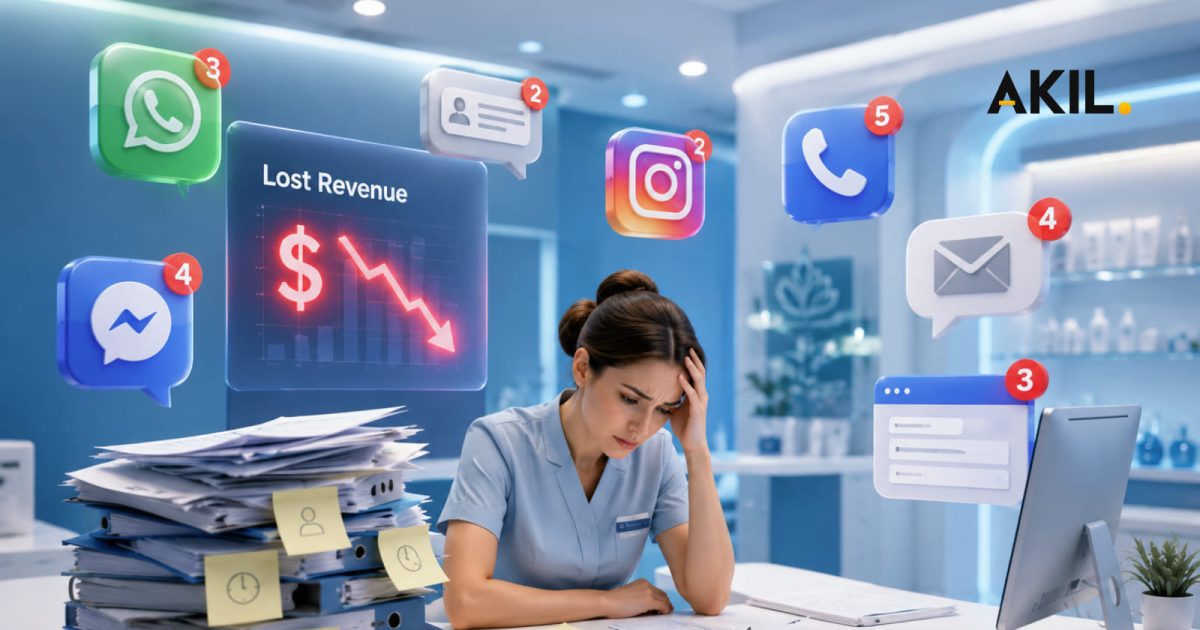
TL;DR
Manual lead tracking causes clinics to lose 30–50% of patient inquiries, silently draining up to $10,000 per month in unrealized revenue. Delayed responses, missed after-hours messages, and HIPAA-risky spreadsheets are the main culprits. Automation solves all three. Read on to learn exactly how.
If your clinic is still managing patient inquiries with spreadsheets, sticky notes, and manual follow-up calls, you are not just operating inefficiently, you are actively losing patients to competitors who respond faster. Manual lead tracking in healthcare settings is one of the most underestimated sources of revenue loss in the industry, and the damage compounds every single day your systems stay the same.
Research from clinic operators and marketing professionals communities reveals a pattern that repeats itself in med spas, aesthetic clinics, dental practices, and healthcare offices worldwide: potential patients reach out, receive no response in time, and book elsewhere. Not because the clinic was not good, but because the process failed them.
Key Takeaways
| Point | Details |
| Lost Revenue | Clinics lose up to $10,000/month from untracked inquiries. |
| Response Speed | Manual systems delay replies; automation responds in under 30 seconds. |
| HIPAA Risk | Using Google Sheets for patient data is not HIPAA-compliant. |
| Invisible Problem | Most clinics don’t know how many leads they’re silently losing. |
| Patient Tolerance | Patients accept automated responses when they actually solve problems. |
| After-Hours Gap | Instagram/after-hours inquiries go unanswered until the next day. |
What Is Manual Lead Tracking, And Why Do Clinics Still Use It?
Manual lead tracking is the practice of recording, following up with, and managing potential patient inquiries through non-automated means, think spreadsheets, paper logs, phone call notes, and personal inboxes. It works by relying on individual staff members to manually capture, categorize, and respond to every incoming lead. Unlike CRM-based systems or automation platforms, manual tracking depends entirely on human consistency, availability, and memory.
Many clinics started this way when their patient volume was small enough to manage. The problem is that most never upgraded their systems to match their growth. A front-desk coordinator managing 10 inquiries per week can cope. That same person managing 80 inquiries per week across WhatsApp, Instagram DMs, phone calls, and email cannot, and something will fall through.
The other reason clinics stick with manual systems is deceptively simple: they don’t know what they’re losing. Missed leads don’t announce themselves. There is no alert that says “Patient A messaged at 9 PM and never heard back.” The revenue leaks silently, and the clinic continues operating under the assumption that their current process is working fine.
How Manual Lead Tracking Fails Clinics: 4 Breakdown Points
Manual tracking doesn’t fail all at once. It fails in predictable, repeatable stages. In our experience auditing patient acquisition systems for healthcare businesses, we consistently find the same four failure points regardless of clinic size or specialty.

Breakdown 1: The After-Hours Gap
The majority of patient inquiries do not come in during business hours. People research treatments and reach out in the evenings, on weekends, and during lunch breaks. With manual tracking, any inquiry that arrives outside staffed hours sits unanswered until the next morning. In competitive markets, that patient has already booked with a competitor by 9 AM.
Breakdown 2: The Multi-Channel Blind Spot
Modern clinics receive inquiries across phone, email, Instagram DMs, Facebook Messenger, WhatsApp, and website contact forms. Manual tracking requires a staff member to actively monitor and log each channel. In practice, channels get missed, especially Instagram and WhatsApp, which are treated as secondary to the main phone line but increasingly preferred by younger, high-value patient demographics.
Breakdown 3: Inconsistent Follow-Up
Manual follow-up depends on who is working that day, how busy they are, and whether they remember to check their notes. Research from clinic operators confirms that follow-up consistency drops sharply after the first contact attempt. Most manual systems have no mechanism to remind staff to follow up with a lead who didn’t respond on day one. That lead expires quietly.
Breakdown 4: No Audit Trail
When a lead does fall through, manual systems offer no data to diagnose why. There is no timestamp showing when the message arrived, no record of whether anyone responded, and no pipeline view showing which leads are stuck. Without visibility, the problem cannot be fixed, and it will repeat itself indefinitely.
Why Manual Lead Tracking Matters in 2026: Key Statistics
The financial and operational case against manual lead tracking has never been clearer. The following figures, drawn from industry research, practitioner case studies, and healthcare marketing analysis, quantify what most clinic owners only sense intuitively.
- 30–50% of clinic inquiries go unacknowledged when manual tracking is the primary system. For a clinic receiving 60 inquiries per month, that is 18–30 patients lost before any consultation occurs.
- Up to $10,000 per month in lost revenue has been documented in single-clinic case studies where inquiries fell through the cracks, calls went unmissed, and follow-ups were never completed.
- Response times under 5 minutes increase lead conversion by 9x compared to responding after 30 minutes (Harvard Business Review, 2011, a finding that has only become more relevant as patient expectations accelerate).
- Google Sheets and unencrypted spreadsheets are not HIPAA-compliant under the U.S. Health Insurance Portability and Accountability Act. Clinics using them for patient data face potential fines starting at $100 per violation and escalating to $50,000+ per category (U.S. Department of Health and Human Services, 2023).
- Automated response systems cut reply time from hours to under 30 seconds according to operational data from clinics that have migrated to WhatsApp Business API and CRM automation.
Taken together, these figures describe a situation where the cost of inaction is measurable, cumulative, and entirely avoidable.
Manual Lead Tracking vs. Automated Lead Tracking: Key Differences
The operational contrast between manual and automated systems is stark. Below is a direct comparison across the dimensions that matter most to a growing clinic.
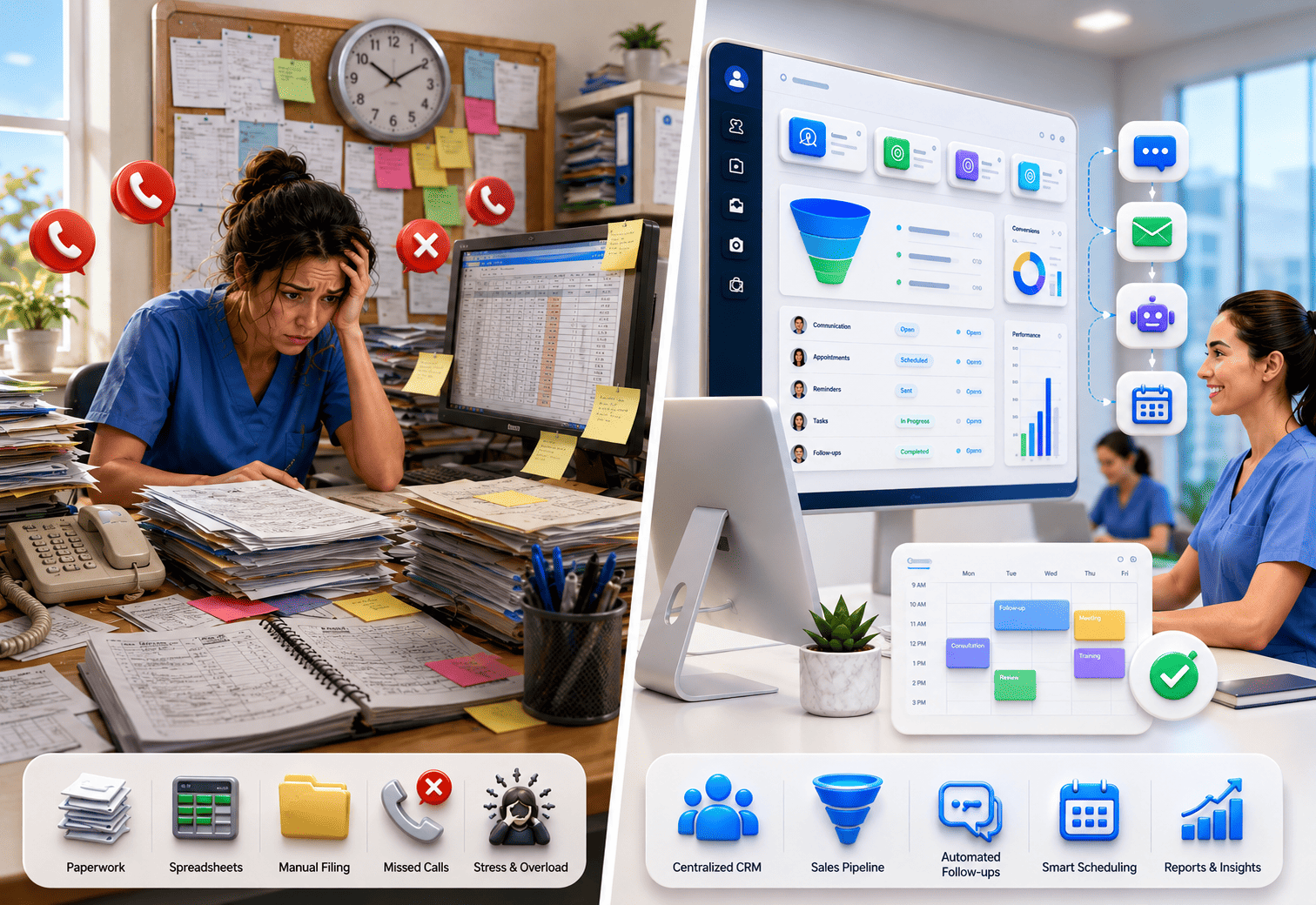
| Factor | Manual Lead Tracking | Automated Lead Tracking |
| Response Time | Hours (or next day) | Under 30 seconds |
| After-Hours Coverage | None | 24/7 automated response |
| Lead Logging | Pen-and-paper / Google Sheets | CRM or auto-log to shared sheet |
| HIPAA Compliance | High risk (spreadsheets) | Compliant platforms available |
| Staff Workload | High, every follow-up is manual | Automated sequences reduce load |
| Lead Loss Rate | 30–50% of inquiries missed | Near-zero with proper automation |
| Monthly Cost of Errors | Up to $10,000 in lost revenue | One-time setup + low monthly fee |
| Best For | Clinics with < 5 monthly inquiries | Any clinic managing growth at scale |
For clinics at any meaningful scale of patient acquisition, the table above describes a one-sided comparison. The case for automation is not about sophistication, it is about operational reliability. A common objection we hear from clinic owners is: “Our team knows our patients better than a bot ever could.” That concern is valid for relationship-building, but it misses the point. Automation is not replacing the clinical relationship; it is ensuring that the inquiry gets captured and acknowledged so that relationship can actually begin.
How to Fix Manual Lead Tracking in Your Clinic: 6 Step Framework
Transitioning from manual to automated lead management does not require a complete overhaul. From working with healthcare businesses across medspa, dental, and aesthetic clinic verticals, we have found the following framework produces the most reliable results with the least disruption.
Step 1: Audit Your Current Inquiry Channels, List every platform where patients can contact your clinic: phone, email, Instagram, Facebook, WhatsApp, website form, Google Business profile messages. If you cannot name them all from memory, you already have a gap. Document each channel, who monitors it, and what the expected response time is.
Use a tool like Google Analytics or Meta Business Suite to understand which channels drive the most inbound volume. Prioritize automation there first.
Step 2: Implement a CRM Built for Healthcare, Choose a CRM that centralizes all inquiry sources into a single inbox. GoHighLevel and HubSpot both support multi-channel intake. For HIPAA-sensitive environments, ensure your CRM vendor provides a Business Associate Agreement (BAA), most major platforms offer this upon request.
Step 3: Set Up Automated First-Response Sequences, Configure an instant reply for every new inquiry that acknowledges receipt, provides clinic hours, and offers a booking link or next step. This response should fire within 60 seconds of the inquiry arriving. On WhatsApp Business API, this can be achieved with a simple welcome message workflow. For email, most CRMs support automated reply sequences natively.
In real-world deployment, response times have dropped from several hours to under 30 seconds with this single change, dramatically reducing the window in which patients defect to competitors.
Step 4: Build a Follow-Up Drip Sequence, Not every inquiry converts on first contact. Build a 3–5 message follow-up sequence for leads who do not book within 24–48 hours. This sequence should be channel-appropriate (SMS/WhatsApp for mobile-first patients; email for those who reach out via form). Set delays of 24 hours, 48 hours, and 5 days between messages.
Step 5: Create a Shared Lead Log, Even in automated systems, transparency matters. Configure your CRM or a shared, HIPAA-compliant document to log every incoming inquiry with a timestamp, source, status, and assigned staff member. This gives clinic managers real-time visibility into lead volume and conversion rates without relying on staff memory.
Step 6: Review and Optimize Monthly, Automation is not a set-and-forget solution. Review your lead pipeline monthly: what percentage of inquiries converted to consultations? Which channel drives the highest-quality leads? Where in the sequence are leads dropping off? Use these answers to refine your sequences and staffing allocation quarterly.
Lead Tracking Tools and Resources for Clinics
These platforms are widely used in healthcare and aesthetic clinic environments for automating and managing patient lead workflows. Each has been selected based on healthcare suitability, automation capability, and HIPAA-compliance pathways.
| Tool | What It Does | Best For |
| HubSpot CRM | Full-featured CRM with patient/lead pipeline management | Multi-channel lead tracking |
| GoHighLevel | All-in-one CRM + automation for medical and medspa clinics | SMS/WhatsApp/email automation |
| Cliniko | Practice management + patient booking system | Healthcare-specific workflows |
| Zapier | No-code workflow automation connecting 6,000+ apps | Connecting intake forms to CRM |
| WhatsApp Business API | Automated messaging via WhatsApp for patient inquiries | After-hours patient response |
| PatientPop | Reputation, booking, and lead management for healthcare | End-to-end patient acquisition |
When evaluating any of the above tools, always request a Business Associate Agreement (BAA) from the vendor before storing patient information. This is non-negotiable for HIPAA compliance.
Common Manual Lead Tracking Mistakes to Avoid

Mistake 1: Treating Instagram DMs as Informal, Many clinic operators treat Instagram messages as low-priority compared to phone calls or emails. In reality, a growing segment of patients, particularly those seeking aesthetic, medspa, and wellness services, prefer to initiate contact via Instagram. Ignoring or delaying responses to DMs can cost you high-value bookings. Connect Instagram to your CRM inbox to treat it with the same urgency as a phone call.
Mistake 2: Using Personal Email Inboxes to Track Leads, When inquiries go to a single staff member’s personal inbox, they become invisible to the rest of the team. If that person is on leave, ill, or overloaded, leads sit unread. All inquiry channels should route to a shared, team-accessible inbox or CRM.
Mistake 3: Storing Patient Data in Unencrypted Spreadsheets, Google Sheets is not HIPAA-compliant out of the box. Beyond compliance risk, spreadsheets lack the audit trails, access controls, and encrypted storage that healthcare data requires. Transition patient contact data to a compliant CRM before a regulatory review forces the issue.
Mistake 4: No Follow-Up After the First Message, The majority of leads do not convert on the first touch. If your process is “send one email and wait,” you are leaving 60–70% of potential conversions on the table. Build a structured follow-up sequence of at least 3 touchpoints across different channels.
Mistake 5: Measuring Success by Inquiries Received, Not Inquiries Converted, A clinic with 100 monthly inquiries and a 20% conversion rate is not performing better than a clinic with 60 inquiries and a 55% conversion rate. Track your inquiry-to-consultation rate, your consultation-to-booking rate, and the average revenue per converted lead. These are the numbers that reveal the true cost of manual tracking.
Frequently Asked Questions About Manual Lead Tracking in Clinics
What is the biggest risk of manual lead tracking for healthcare clinics?
The biggest operational risk is silent revenue loss, patients who never receive a timely response and book elsewhere without the clinic ever knowing they tried to get in touch. Beyond revenue, the biggest regulatory risk is storing patient data in non-compliant tools like Google Sheets or personal email, which exposes clinics to HIPAA violation fines starting at $100 per incident.
How much revenue can a clinic lose from poor lead tracking?
Based on documented case studies from clinic operators, the figure can reach $10,000 per month for clinics receiving moderate to high inquiry volumes. This accounts for missed calls, unacknowledged messages, and failed follow-ups. For high-volume medspa and aesthetic clinics, the number can be significantly higher depending on average treatment value.
Why do patients choose competitors after sending an inquiry?
The primary driver is response time. Research consistently shows that the clinic that responds first to an inquiry wins the booking in the majority of cases, even when the competing clinic has lower prices or fewer reviews. Patients who reach out are in a decision-making window; if they don’t hear back within minutes to hours, that window closes and they move to the next option.
When should a clinic switch from manual to automated lead tracking?
The inflection point is typically when your clinic handles more than 20–25 new patient inquiries per week across two or more channels. Below that volume, a disciplined manual process may be sufficient. Above it, human consistency alone cannot guarantee that every inquiry is captured and followed up on in time to compete. If you’re already missing calls or responding hours late, the threshold has been crossed.
Can automated systems actually replace human patient communication?
No, and they shouldn’t. Automation handles the first-response and follow-up sequences that keep leads warm; human staff handle consultations, clinical questions, and the relationship-building that drives loyalty and referrals.
The most effective systems use automation to ensure no lead falls through before it reaches a human, not to replace that human entirely. Importantly, patients are receptive to automated responses when those responses actually solve their problem, the key is that the bot must be genuinely helpful, not a dead end.
Which CRM platforms are HIPAA-compliant for clinic lead management?
GoHighLevel, HubSpot, Salesforce Health Cloud, and PatientPop all offer HIPAA-compliant configurations, provided you request and execute a Business Associate Agreement (BAA) with the vendor.
Free or consumer-grade tools, including standard Google Workspace, personal email, and social media platforms, are generally not HIPAA-compliant without enterprise configurations and BAAs. Always confirm compliance capability directly with your vendor before onboarding patient data.
Stop Losing Patients to a Process Problem You Can Fix
Manual lead tracking is not a staffing problem or a budget problem. It is a systems problem, and systems problems have systems solutions. The clinics losing 30–50% of their patient inquiries are not bad clinics. They are good clinics running outdated processes that cannot keep pace with modern patient behavior.
The framework above, audit, centralize, automate first response, build follow-up sequences, log transparently, and optimize monthly, has taken clinics from 5 figure monthly revenue losses to consistent, measurable patient acquisition growth. The technology exists, the costs are justified by the first recovered booking, and the setup is simpler than most clinic owners expect.
Ready to audit your clinic’s lead management?
Our team works with clinic owners and healthcare marketing leaders to identify exactly where patient inquiries are falling through and build the automated systems to stop the leak, no commitment required for an initial assessment.
No pressure, no commitment. We’ll show you exactly where your system is losing patients and what a working alternative looks like.