TL;DR: Most SaaS websites convert just 2% to 8% of visitors into trials or customers, even with strong traffic. Website conversion rate optimization fixes the 5 biggest leaks: unclear messaging, cluttered pricing, friction-heavy forms, slow onboarding, and weak social proof. Fix them, and you increase SaaS software sales without spending more on ads.
Key Takeaways
| Point | Details |
| Average SaaS conversion | Most SaaS sites convert 2% to 8% of visitors; top performers run several times higher |
| Biggest conversion killer | Unclear value proposition is the top reason SaaS visitors leave before signing up |
| Pricing page friction | Pricing pages with 4+ tiers convert about 31% worse than three-tier layouts |
| Onboarding speed | Fast time-to-value predicts conversion better than pricing or design does |
| Social proof impact | Specific, verified testimonials near a CTA can lift conversion by double digits |
| CRO beats ad spend | A single point of conversion lift can cut customer acquisition cost by 15% to 25% |
Your SaaS site can pull in thousands of visitors a month and still miss its revenue targets by a wide margin. That gap rarely comes from a traffic problem. Instead, it comes from a conversion problem, and website conversion rate optimization is the discipline built to close it.
We have spent years running conversion audits for SaaS companies, marketplaces, and service businesses around the globe.We have reviewed everything from homepage messaging to full customer journeys on desktop and mobile.
The pattern repeats constantly: a strong product, decent traffic, and a website that quietly turns paying customers away at 5 predictable points. This guide breaks down what website conversion rate optimization means for a SaaS business. You will see what a realistic SaaS conversion rate optimization benchmark looks like in 2026.
More importantly, you wil get the 5 conversion killers behind most lost revenue, along with the fixes that close each gap. That’s how you increase SaaS software sales without adding a cent to your ad budget.
Is Your B2B SaaS Sales Funnel Actually Converting, or Just Collecting Signups?
Conversion rate optimization is the structured process of turning more site visitors into people who take a specific action. That action might be starting a free trial, booking a demo, or upgrading to a paid plan.
It combines behavioral data, user research, and controlled testing to find friction points, then removes them one at a time. For the rest of this guide, We will shorten it to CRO where that keeps the writing tighter.
For a SaaS company, conversion rarely means a single purchase the way it does in ecommerce. Instead, SaaS conversion rate optimization has to account for a longer chain of events. Visitor becomes signup, signup becomes activation, activation becomes paid customer, and paid customer becomes expansion revenue.
Optimizing only the first step, while ignoring the rest, is a common mistake. It’s why so many SaaS companies watch traffic grow while revenue stays flat. The math behind this compounds quickly. A conversion rate is simply conversions divided by total visitors, multiplied by 100.
If 5,000 people visit your pricing page and 150 start a trial, your conversion rate is 3%. Improve that single number to 4.5%, and you have added 50% more trials without spending an extra dollar on acquisition.
How Is SaaS Conversion Rate Optimization Different From Ecommerce CRO?
Ecommerce CRO usually optimizes toward one moment: the purchase. SaaS conversion rate optimization, however, has to manage multiple moments strung together, often across weeks.
A visitor might convert to a trial in minutes. Converting that same trial user to a paying customer can take 2 more weeks, depending on the value they experienced during onboarding.
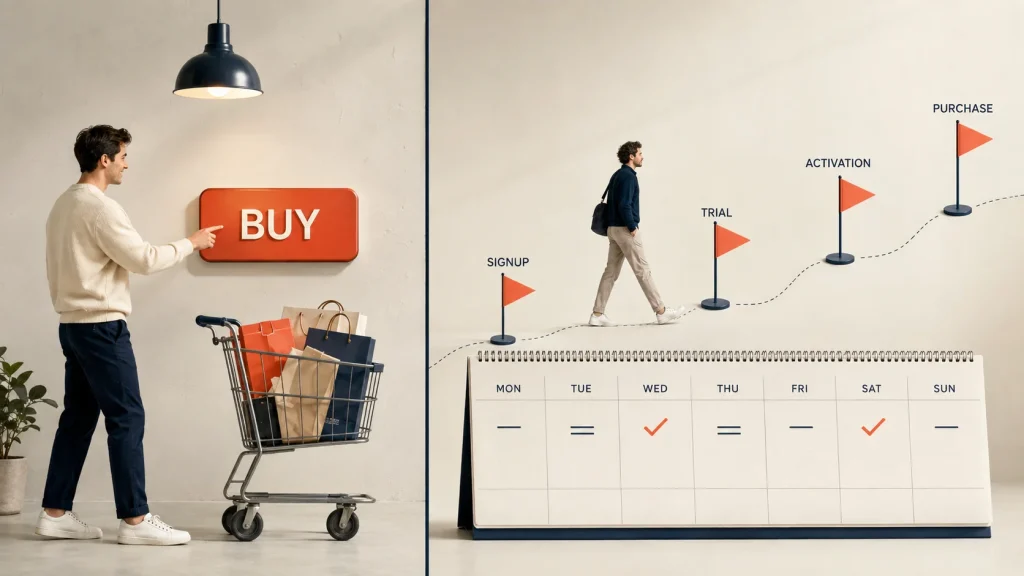
This is why website conversion rate optimization for SaaS leans so heavily on activation metrics rather than just top-of-funnel signups. A free trial signup that never opens the product again isn’t a win. It’s a lead that looks converted on a dashboard but never actually becomes SaaS software sales.
What’s a Good SaaS Conversion Rate in 2026?
Before diving into tactics, it helps to know where you currently stand against the market. “What’s a good conversion rate?” is one of the most common questions we hear during a CRO Overview.
Honestly, the answer depends on where in the funnel you’re measuring and which trial model you run. At the top of the funnel, visitor-to-trial conversion for B2B SaaS typically runs between 2% and 5%. Leading companies push past 10%.
Further down the funnel, the median SaaS landing page converts at just 3.8%, which is 42% below the 6.6% median across all industries combined (Unbounce Conversion Benchmark Report, 2026). That gap exists largely because SaaS products are harder to explain in a single glance than a simple retail item.
However, free-to-paid conversion tells a different story depending on the model you run. A January 2026 survey of 200 B2B software products found a median free-to-paid conversion rate of 8%. That figure blends every trial and freemium type together (ChartMogul SaaS Conversion Report, 2026).
Free trials that required a credit card upfront converted at 30%, more than five times higher than trials that didn’t. Freemium products with no trial period at all tend to convert lower still, often close to 5%. That said, the best product-led growth companies push that figure two to three times higher (OpenView Partners Product Benchmarks).
Here’s how those benchmarks stack up side by side:
| Funnel Stage | Typical Range | Top Performers |
| Visitor → free trial or demo signup | 2% – 5% | 10%+ |
| SaaS landing page (blended traffic) | 3.8% median | Multiples above median |
| Free-to-paid (trial and freemium blended) | 8% median | 15% – 20% |
| Free trial, credit card required at signup | 30% | 5x higher than no-card trials |
| Freemium → paid (no trial) | ~5% | 2–3x median at top PLG firms |
It’s worth noting that analysts don’t fully agree on a single “average” figure for website conversion rate optimization benchmarks. That’s a genuinely contested point, and it’s worth sitting with rather than glossing over.
Contentsquare’s 2026 Digital Experience Benchmark Report is drawn from 99 billion sessions across more than 6,500 sites. It found that overall conversion rates have softened year over year, even as revenue per visit holds steady (Contentsquare, 2026).
In contrast, other trackers, including DemandSage’s compiled data, put the average conversion rate across all industries closer to 2.9% (DemandSage, 2026).
Both views can be true at once. Aggregate averages are softening as AI-driven research shifts casual browsing away from company websites. Meanwhile, the visitors who do arrive convert at a similar or higher rate, simply because they’re further along in their decision.
In my own audits, we treat published benchmarks as a sanity check rather than a target. A 3% conversion rate can be excellent for an enterprise SaaS product with a large average contract value. That same rate would be mediocre for a low-cost, self-serve tool built to convert at a much higher volume.
How Website Conversion Rate Optimization Increases SaaS Software Sales
More traffic feels like the obvious growth lever, but it’s usually the most expensive one. Paid acquisition costs keep climbing. Meanwhile, a visitor who bounces off a confusing homepage is gone, whether you paid two dollars or twenty to bring them there.
Website conversion rate optimization increases SaaS software sales by making your existing traffic work harder. That’s why it consistently produces a better return than simply buying more clicks.
The financial logic is straightforward. Ruler Analytics found the average conversion rate across 14 industries sits at 2.9%(Paddle, 2026). Even a modest lift off that baseline compounds fast.
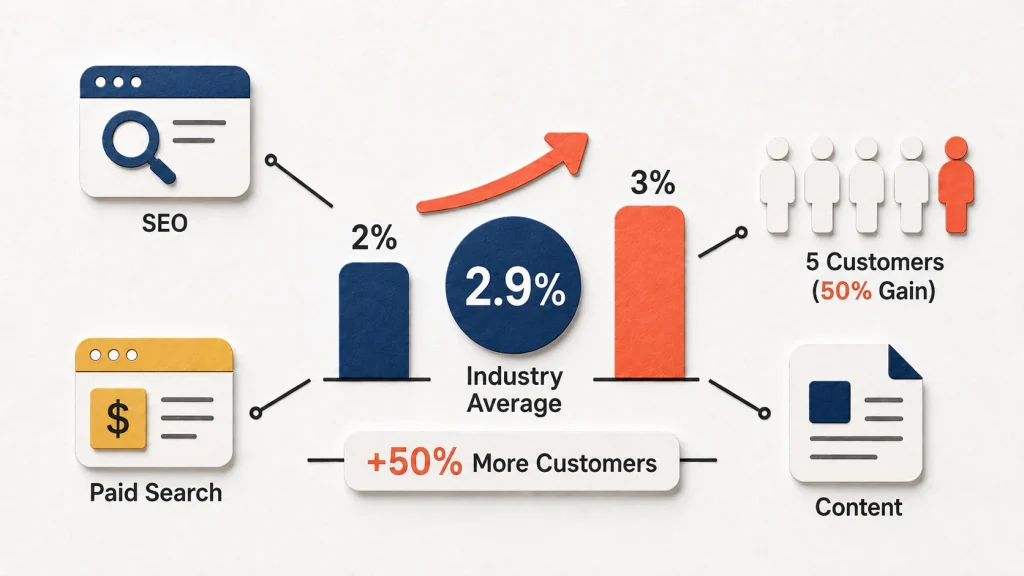
Raising a landing page from 2% to 3% conversion doesn’t just add one percentage point. It adds 50% more customersfrom the same ad spend. As a result, every dollar already invested in SEO, paid search, and content marketing starts returning more.
SaaS economics amplify this effect further. Conversion improvements at each funnel stage stack multiplicatively, rather than additively. Lift visitor-to-trial conversion by 20% and trial-to-paid conversion by 10%, and the overall gain isn’t 30%.
It’s roughly 32%, because each improvement compounds on the one before it. Meanwhile, competitors who treat conversion as a core growth lever compound their own advantage every quarter. That widens the revenue-per-visitor gapbetween their site and yours.
There’s a valuation angle too, and board members and investors care about it directly. A widely cited 2026 SaaS benchmark analysis found something striking. Companies with trial-to-paid conversion rates in the top quartile commanded revenue multiples 2.7 times higher than bottom-quartile performers (ConversionXperts, citing OpenView Partners data, 2026).
That gap held even when annual recurring revenue was comparable. Investors read a strong conversion rate as proof that your go-to-market motion is repeatable. That matters nearly as much as the revenue number itself.
5 Biggest SaaS Conversion Killers (And How to Fix Each One Fast)
Across every CRO Overview and In-Depth Analysis We have run, the same 5 problems show up again and again. Industry and price point rarely matter. Here’s each one, why it costs you signups, and the fastest fix.
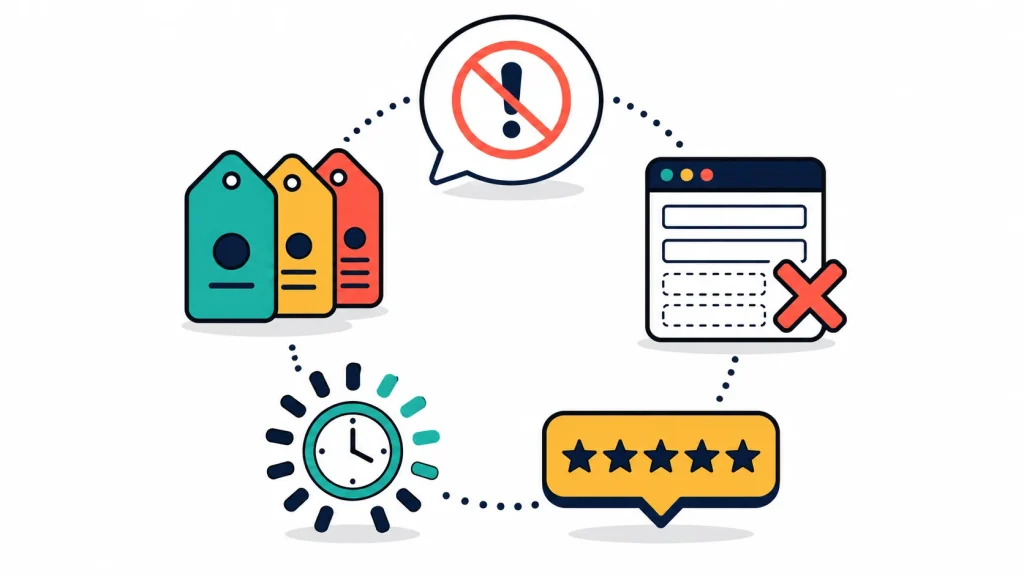
1. Message Mismatch on Your Homepage: Visitors decide whether your product is relevant to them within seconds of landing. If your headline talks about features instead of outcomes, visitors bounce immediately. The same happens when the page doesn’t match what the ad or search result promised: they leave before ever seeing your value proposition.
The fix: Rewrite your above-the-fold headline around the specific outcome your ideal customer wants, not a feature list. Match your landing page messaging to the exact campaign, keyword, or referral source that brought the visitor there. Message continuity is one of the strongest predictors of whether someone stays past the first screen.
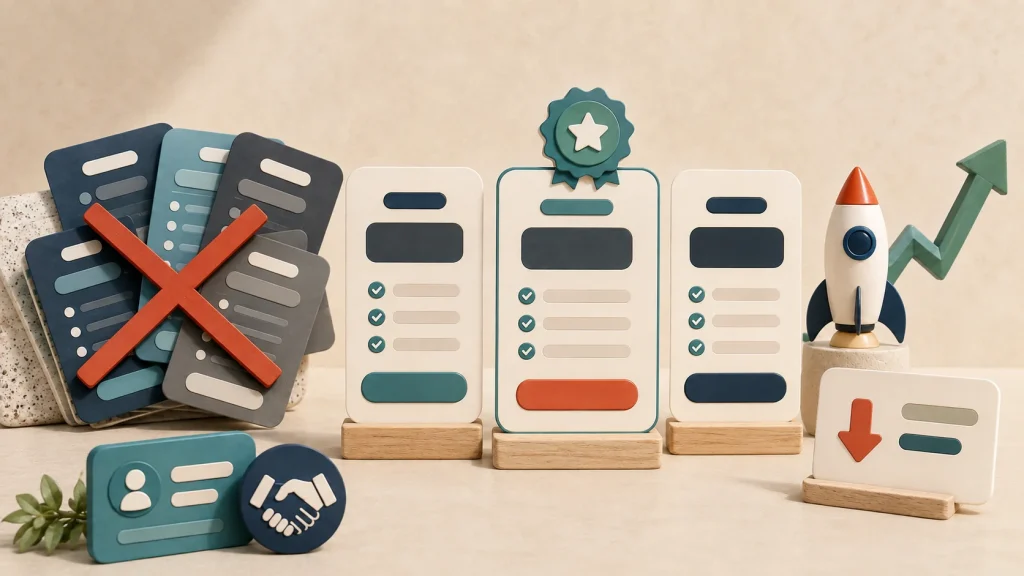
2. Cluttered or Confusing Pricing Pages: Pricing pages carry an outsized share of the conversion burden because they’re usually the last stop before signup. Yet many SaaS pricing pages pack in five or six tiers with overlapping features, which paralyzes visitors instead of guiding them.
Pricing pages with 4+ tiers convert about 31% worse than clean three-tier layouts (InfluenceFlow, 2026). Separately, 86% of B2B buyers say transparent pricing directly influences their purchase decision (Huemor, 2026). This is exactly why SaaS conversion rate optimization treats the pricing page as its own dedicated project, not an afterthought.
The fix: Cut down to three tiers with a clearly highlighted recommended plan. One SaaS team reduced their tiers from five to three and added a “Most Popular” badge. Conversion jumped from 1.2% to 3.1%, a 158% lift, without changing a single price (PipelineRoad case study via 925Studios, 2026).
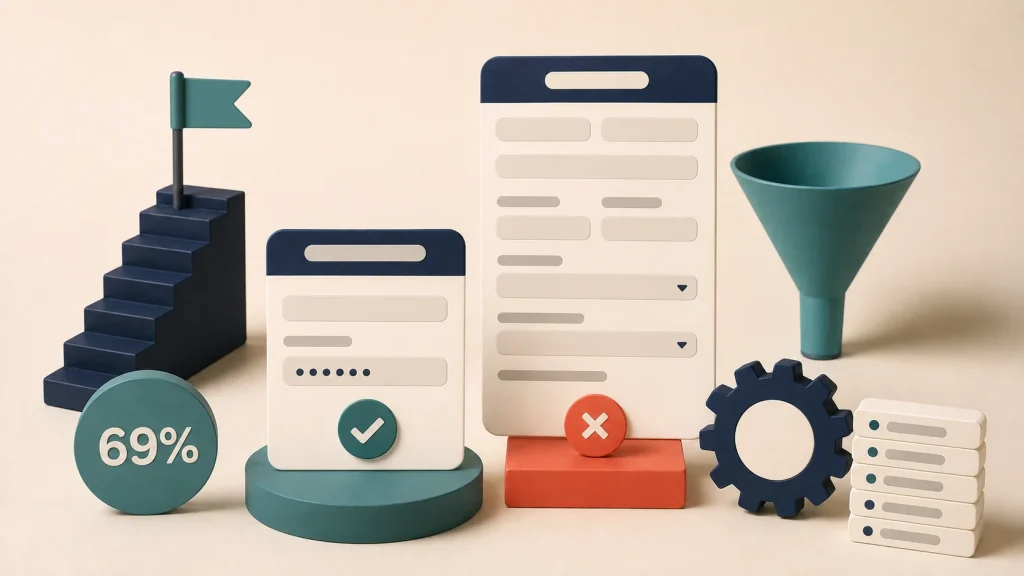
3. High-Friction Signup and Trial Forms: Every additional form field is a small tax on your conversion rate. According to a 2026 breakdown of Unbounce’s benchmark data, single-field forms convert at 13.4%, three-field forms at 10.1%, and nine-field forms drop to 3.6%(Digital Applied, 2026).
Multi-step forms outperform single-page forms with the same field count, by 21% on average. That’s because visitors commit after the first step and carry that momentum forward.
The fix: Ask only for an email and password at signup. Move company size, use case, and other qualifying questions into onboarding instead. There, they can double as personalization inputs rather than signup friction.
4. Slow Time-to-Value in Onboarding: This is the killer most SaaS teams underestimate, because it hides inside the product rather than on the marketing site. Trials that reach their activation milestone within the first 24 hours convert to paid at 2.3 times the rate. That’s compared to trials that activate after day three (ChartMogul SaaS Retention Report, cited in Arcade, 2026).
Meanwhile, the average trial signup-to-activation rate across SaaS sits at just 37.5% (Userpilot benchmark data, cited in Discovered Labs, 2026). That means most trial users never even reach the moment your product was built to deliver.
The fix: Define the one action that correlates most strongly with retention. Slack famously defined it as a team sending 2,000 messages. Then rebuild your first session around getting new users to that action fast. Skip the generic feature tour.
5. Missing or Generic Social Proof: “Trusted by thousands of businesses” persuades almost no one anymore. Visitors want specific, verifiable proof that people like them succeeded with your product. When comScore ran a multivariate test on testimonial placement and design on its homepage, conversions increased by 69% (case study via Ventureharbour, 2026).
Similarly, a hospitality management school that added a single testimonial above its lead generation form saw form submissions climb 50% (VWO, 2026).
The fix: Replace generic trust badges with named client results and verified review scores from sites like G2 or Capterra. Choose testimonials that cite a specific number rather than a vague compliment. Place proof directly next to your highest-friction CTA (call-to-action), not buried on a separate page.
5 Stage Conversion Rate Optimization Process We Run with Every SaaS Client
Random testing rarely compounds into real growth for SaaS conversion rate optimization. The SaaS companies that consistently outperform their benchmarks follow a repeatable process. They don’t just chase whichever page looks weakest that week.
Here is the framework we walk clients through, whether we are starting with a single-page review or a full audit.
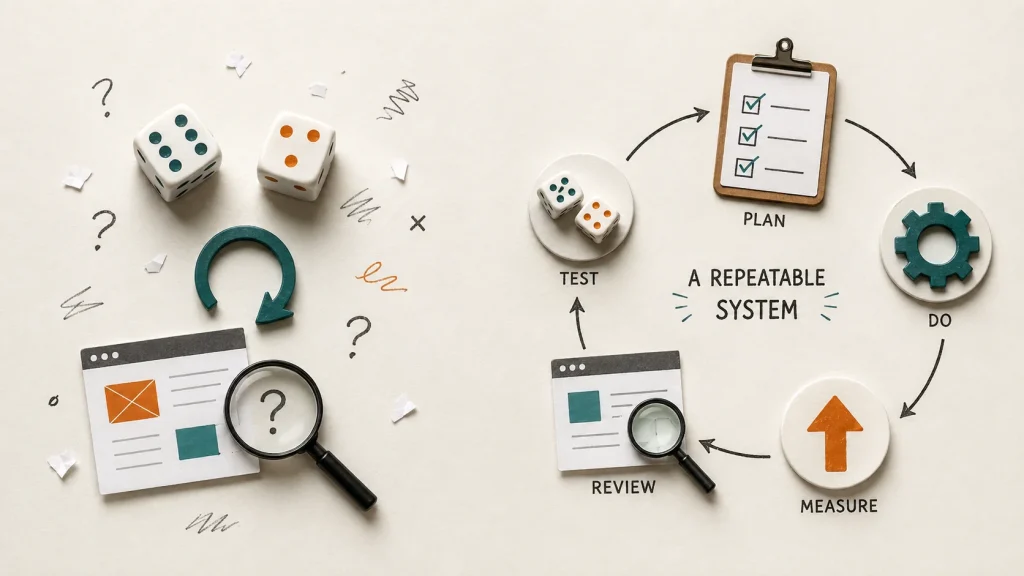
- Benchmark and audit. Start with a clear-eyed review of one high-traffic page, typically the homepage or pricing page, across both desktop and mobile. The goal is a short list of the highest-impact issues, not an exhaustive report nobody will act on.
- Map the journey. Once the quick wins are identified, widen the lens to the full journey. That means every conversion foundation: calls-to-action, trust signals, value proposition clarity, navigation, page speed, and messaging. This is where most of the compounding gains live. Fixing five small leaks together beats fixing one big leak in isolation.
- Prioritize ruthlessly. Score each issue by how many visitors it affects and how hard it is to fix. Then tackle high-impact, low-effort changes first, to build momentum before larger structural tests.
- Test with discipline. Run experiments for at least two to four weeks, to account for weekly traffic patterns. Test one meaningful variable at a time, so you know exactly what drove the result.
- Go deep. Once the foundational issues are fixed, go deeper on your single biggest lever. That might be analytics and heatmap analysis, mobile UX, funnel and traffic quality, customer segmentation, or a structured A/B testing plan. Any of these, done well, tends to unlock the next tier of gains.
This is essentially the structure behind my own CRO Overview, In-Depth Analysis, and Advanced Focus audits. Start narrow to build a quick, actionable list. Then widen to the full journey, and go deep on whichever single lever will increase SaaS software sales the most for your specific product.
A typical In-Depth Analysis runs to dozens of pages of prioritized, screenshot-backed findings. We have also translated and audited copy in languages other than English when a client’s audience required it.
Real SaaS Conversion Rate Optimization Case Studies
Benchmarks tell you where you stand. Case studies show what’s actually possible once you fix the right thing. A few results worth noting:
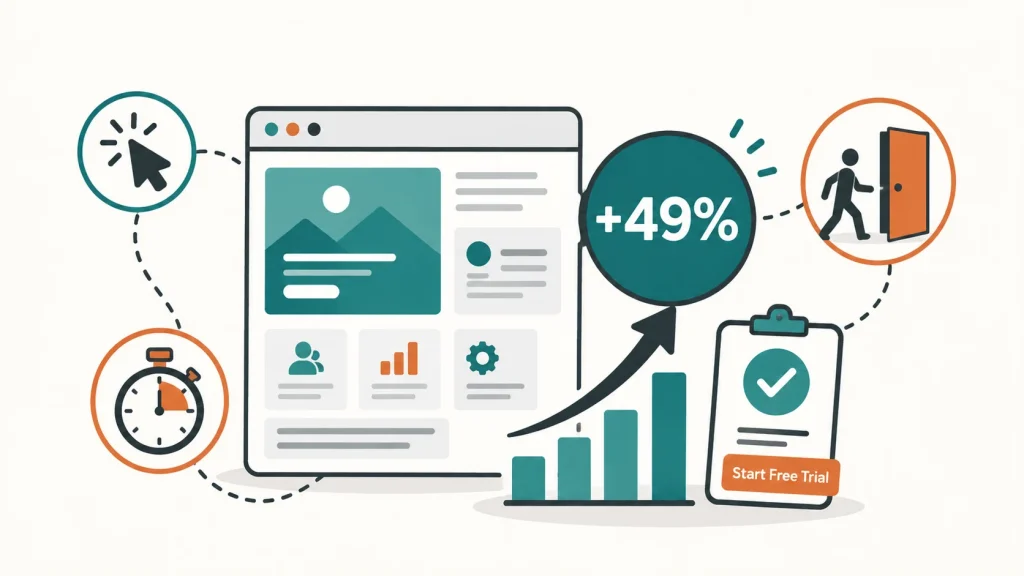
- HubStaff redesigned its homepage and increased visitor-to-trial conversion by 49% (VWO, 2026).
- ArchiveSocial, a SaaS social media archiving platform, streamlined its homepage and demo request page and saw click-through rate climb 101.68% (VWO, 2026).
- A security SaaS company redesigned its primary product page and ran structured A/B tests on navigation, CTAs, and form design. The result: a 240% increase in demo form conversion rate and a 517% increase in total form submissions ((un)Common Logic, 2026).
- Comodo Cybersecurity was already converting at a strong 49.1% on its landing page. Even so, simplifying its messaging for both technical and non-technical audiences gained another 17.5% in visitor-to-lead conversion (case study, 2026).
- UpperHand replaced its gated “Request a Demo” button with an interactive, ungated product tour. Qualified leads increased by 127%, while sales cycle length dropped 23% (Aimers, 2026).
The common thread across all five: none of these teams started with more traffic. Every result came from removing friction that was already costing them customers.
Common Website CRO Mistakes That Cost SaaS Companies Sales
A common objection we hear is this: isn’t it simpler to just buy more traffic than to rebuild pages and run tests for months? It’s a fair question, but traffic and conversion aren’t substitutes. If your visitor-to-trial rate is stuck at 1%, doubling your ad spend doesn’t fix that.
It just gets you twice as many people bouncing off the same broken page, at twice the cost. Fixing the underlying conversion problem, by contrast, multiplies the value of every traffic source you already have, paid or organic.
Beyond that objection, a few specific mistakes show up constantly:
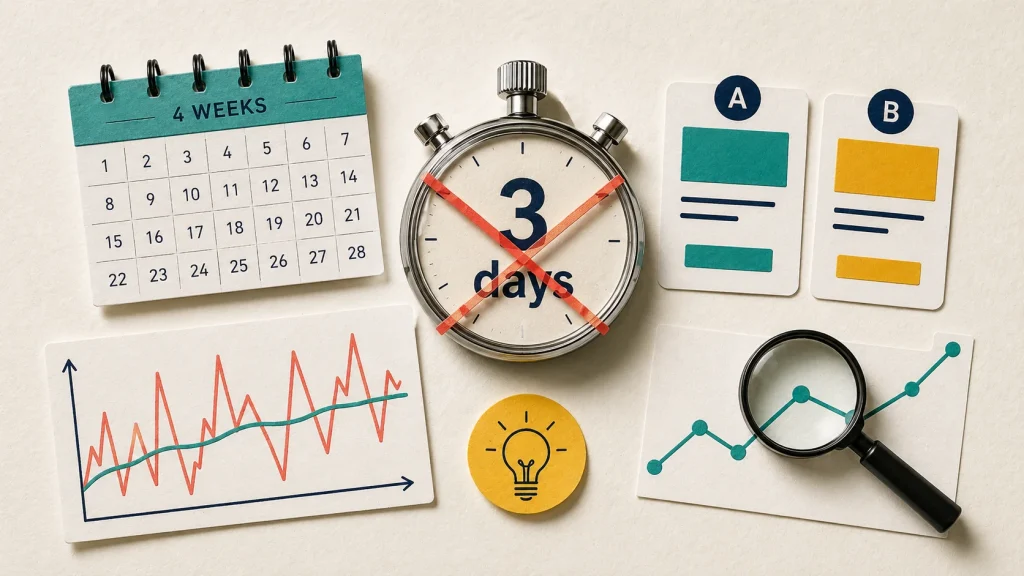
- Testing loosely. Ending a test after three days because one variant is “winning” usually means acting on noise, not a real signal. Most tests need two to four weeks to account for weekly business cycles.
- Wrong benchmark. A 3% trial-to-paid rate looks broken next to a self-serve product’s 20% benchmark. However, that same rate can be perfectly healthy for a sales-assisted enterprise motion with a completely different buyer journey.
- Site-only focus. Conversion rate optimization that stops at the homepage misses where most SaaS revenue is actually won or lost: inside the product, during onboarding.
- Cosmetic changes first. Button colors and font tweaks rarely move the needle compared to fixing message match, pricing clarity, or onboarding speed. Start with the foundation instead.
- One-and-done audits. Conversion rate optimization compounds over multiple cycles. Teams that test consistently, quarter after quarter, pull further ahead of teams that run one project and stop.
How Much Does SaaS Conversion Rate Optimization Cost?
Costs vary widely depending on scope. Standalone CRO tools for heatmaps, session recordings, and A/B testing typically run $10 to $500 a month. Full-service CRO agencies, on the other hand, charge anywhere from $800 to $5,000+ monthly for ongoing programs.
Companies that invest in structured CRO report an average return on investment of 223% (DemandSage, 2026). That helps explain why it keeps winning budget against pure acquisition spend.
You don’t need an ongoing retainer to get started, though. A single, focused audit of your highest-traffic page can surface high-impact fixes without a long-term commitment.
That’s exactly why we structure my own CRO Overview, In-Depth Analysis, and Advanced Focus tiers the way we do. Most SaaS teams get more value from one sharp audit than from months of unfocused testing.
Frequently Asked Questions
What is a good website conversion rate for a SaaS company?
It depends on where you measure. Visitor-to-trial rates of 2% to 5% are typical, with leaders exceeding 10%. Free-to-paid conversion sits at a median of 8% across trial and freemium models combined.
Credit-card-required trials, however, often convert around 30% (ChartMogul SaaS Conversion Report, 2026). Compare your number to your specific model and traffic source rather than a single industry average.
How long does website conversion rate optimization take to show results?
A single-page audit can surface actionable fixes within days. Full A/B tests need 2 to 4 weeks each to reach statistical significance. Most SaaS teams see meaningful, compounding gains after two to three optimization cycles, roughly one quarter of work.
How much does SaaS conversion rate optimization cost?
Tools alone run $10 to $500 a month. Agency retainers range from $800 to $5,000+ monthly. A one-time, focused audit, by comparison, typically costs a few hundred dollars and can be a lower-risk way to start.
Why is my SaaS trial-to-paid conversion rate so low?
Low trial-to-paid conversion is almost always an activation problem rather than a pricing problem. If users aren’t reaching your product’s core value within the first day or two, no amount of email nudging will help.
Can we run conversion rate optimization without hiring an agency?
Yes, for a single high-traffic page. An internal team with access to analytics and a heatmap tool can identify and fix obvious friction points. That said, a structured, third-party audit tends to be faster. It also catches blind spots that internal teams, too close to their own product, often miss.
What’s the difference between conversion rate optimization and A/B testing?
A/B testing is one tool inside conversion rate optimization, not the whole practice. Website conversion rate optimization also includes research, journey mapping, and prioritization frameworks. Together, these decide what’s worth testing in the first place.
Ready to Find Your Biggest Conversion Leak?
Getting traffic isn’t the problem. Converting it is. If visits are strong but signups are flat, one of the five conversion killers above is likely why. We can help you find which one first.
3 ways to start:
- CRO Overview: one page, reviewed on desktop and mobile
- In-Depth Analysis: your full customer journey, start to finish
- Advanced Focus: a deep dive into analytics, mobile UX, funnel quality, segments, or A/B testing
Whichever fits, it’s the lever that will grow your SaaS sales most.