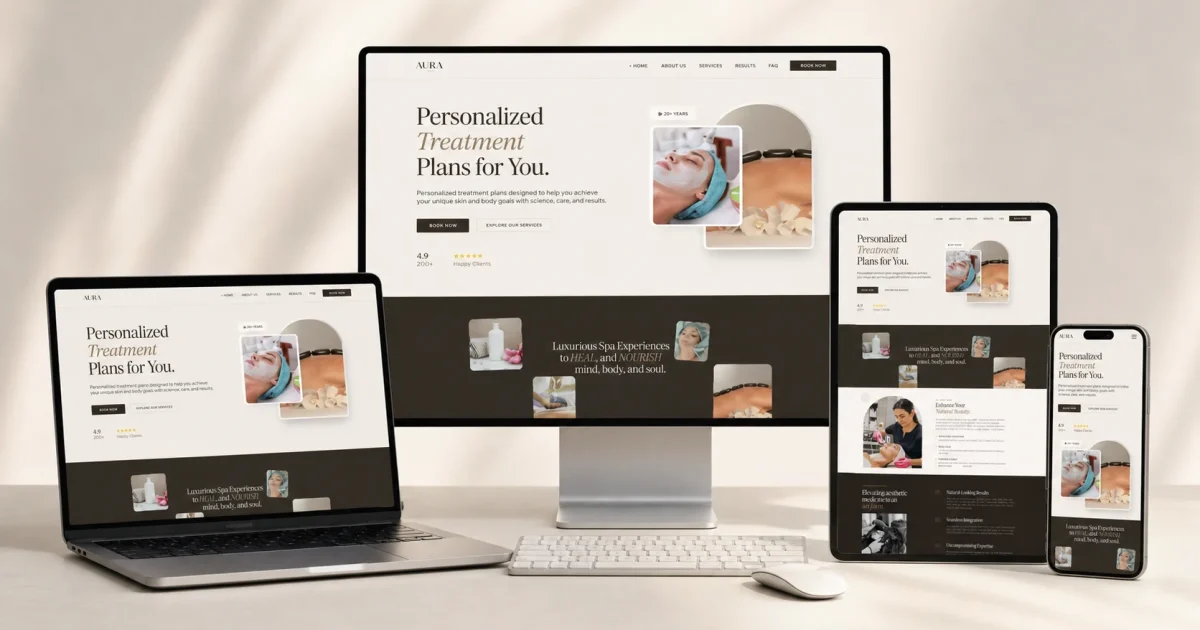
TL;DR: Med spa website design is the strategic process of building an aesthetic clinic’s online presence to attract qualified patient traffic and convert it into bookings. A well-optimized site combines mobile-first architecture, local SEO, trust-building content, and clear conversion pathways. Here’s what you need to know.
Key Takeaways
| Point | Details |
|---|---|
| Mobile-First Is Non-Negotiable | Over 70% of healthcare searches happen on mobile. Build for that first. |
| Trust Drives Conversions | Credentials, real results, and reviews are the primary patient booking triggers. |
| DIY Has Hidden Costs | Time lost to self-builds often costs more than hiring a specialist agency. |
| Local SEO Is Your Lifeblood | Med spas depend on local search your website structure must actively support this. |
| Content Generates Organic Leads | Treatment FAQs and blog posts attract high-intent traffic without paid spend. |
| Speed Is a Revenue Variable | A 1-second page load delay reduces conversions by up to 7% (Google, 2023). |
| Compliance Is Non-Optional | Healthcare ad rules vary by region a non-compliant site is a regulatory risk. |
Build Med Spa Website That Books Patients
Med spa website design is the practice of architecting, building, and optimizing a medical aesthetic clinic’s digital presence to attract qualified patient traffic and convert that traffic into consultations and bookings. It combines healthcare UX best practices, local SEO strategy, trust-building content, and conversion rate optimization into a single, cohesive online presence.

Unlike a general business website, a med spa site must navigate a uniquely complex intersection: it needs to communicate medical authority while projecting aesthetic sophistication, comply with healthcare advertising regulations, and function as a high-converting lead generation tool all at once. A Botox clinic competing in a metropolitan market is not only competing against other med spas. It is competing against dermatologists, plastic surgeons, and national aesthetic chains, all fighting for the same first-page Google rankings.
The best med spa websites are not brochures. They are strategic digital environments designed to answer patient questions, reduce hesitation, and make the path from “I’m curious” to “I’m booked” as friction-free as possible.
How a High-Converting Med Spa Website Works
Understanding the mechanics behind a successful med spa site is the first step toward building one. Here is the framework high-performing aesthetic practices consistently use.
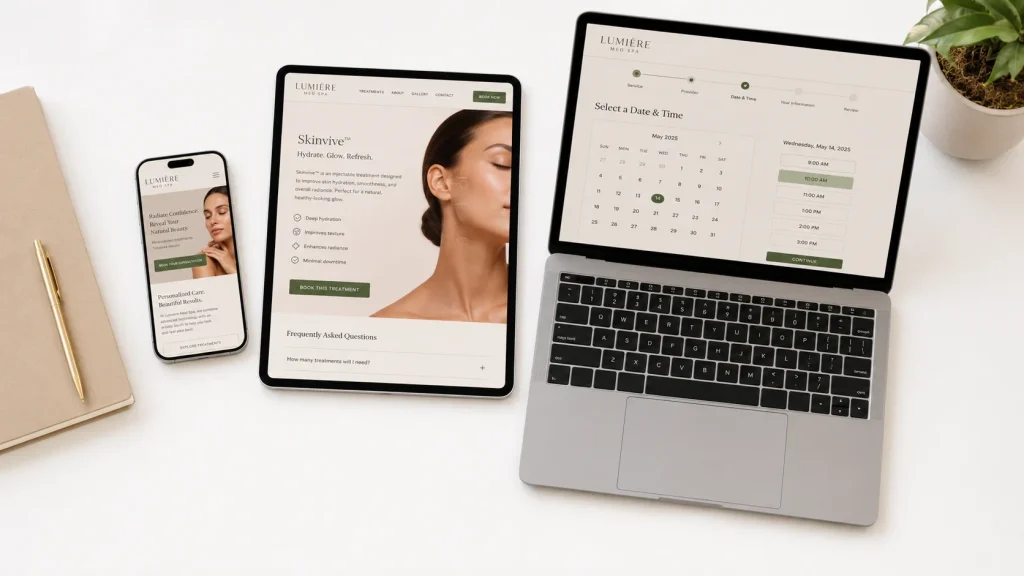
Step 1: Mobile-First Architecture Your site is built and tested for mobile before desktop. More than 70% of aesthetic healthcare searches originate on a smartphone (Statista, 2024). If your site is slow, cluttered, or difficult to navigate on a 6-inch screen, you are losing patients before they ever read a single word about your services. Google’s mobile-first indexing means it ranks your mobile version not your desktop version in search results.
Step 2: Local SEO Foundation Every treatment page, location page, and blog post is built around geo-targeted keyword phrases: “Botox [City]”, “laser hair removal [Suburb]”, “lip filler near me.” Your Google Business Profile is connected, consistent, and populated with accurate NAP (Name, Address, Phone) data. This is the infrastructure that makes you discoverable before a single dollar in paid ads is spent.
Step 3: Trust Hierarchy Content Structure Visitors make subconscious trust assessments within 50 milliseconds of landing on a page (MIT Human-Computer Interaction Research, 2022). Your site is structured to deliver trust signals immediately: professional clinical photography, practitioner credentials displayed above the fold, real patient outcomes, and transparent pricing signals. Trust is not a section of your website it is the architecture.
Step 4: Treatment Pages Built Around Patient Intent Each core service such as injectables, body contouring, skin treatments, laser procedures gets its own dedicated page. These pages are not service listings; they are structured to answer the questions patients actually search: “How much does [treatment] cost?”, “How long does [treatment] last?”, “What does [treatment] feel like?” Answering these questions on-page drives organic traffic and reduces pre-appointment hesitation simultaneously.
Step 5: Clear Conversion Pathways Every page contains a frictionless booking mechanism an online booking widget, a click-to-call button, or a short inquiry form. The fewer steps between “I want this” and “I’m booked,” the higher your conversion rate. For mobile users, this means a sticky header with a call button visible at all times.
Step 6: Reputation Integration Google Reviews, RealSelf listings, and patient testimonials (where permitted under local advertising regulations) are embedded strategically throughout the site not buried in a footer widget, but woven into every trust-critical touchpoint: the homepage hero, individual treatment pages, and the booking page.
How Aesthetic Patients Choose Providers Before Ever Calling
Aesthetic medicine market has shifted decisively online. Patients no longer call around or rely on word-of-mouth alone. They research, compare, and vet providers digitally before making any contact. Here is what the data shows:
- 87% of healthcare consumers begin their provider search online before booking an appointment (Kyruus Health, 2023) — your website is typically the first and most influential patient touchpoint, not your front desk.
- 75% of users judge a business’s credibility based on its website design alone (Stanford Web Credibility Research, 2022) — a dated, template-looking site actively erodes patient confidence before they read a single word about your services.
- 46% of all Google searches have local intent (Google, 2023) for a geographically bound business like a med spa, appearing in local search results is the single highest-ROI digital activity available.
- Aesthetic medicine market is projected to reach $87.5 billion globally by 2030 (Grand View Research, 2024) — competition for patient attention is intensifying every year, and the clinics winning market share are investing in their digital presence now.
- Average patient visits 2–3 provider websites before booking (Accenture Health, 2022) — the sites that win consultations are not necessarily the best clinics; they are the ones with the most credible, clearest digital presence.
- 1 second delay in page load time reduces conversions by up to 7% (Google PageSpeed Insights Research, 2023) — page speed is not a cosmetic concern; it is a direct revenue variable.
Taken together, these statistics point to one strategic reality: in 2026, your med spa website is not a support function. It is your primary business development tool, operating 24 hours a day, seven days a week, in a market that is only growing more competitive.

DIY Website Builder vs. Modern Med Spa Website Design
Key Differences
A recurring debate in clinician communities entering private practice is whether to build a website themselves using platforms like Squarespace or Wix, or to hire a specialist marketing agency. This is a genuinely contested decision. Practitioners with strong technical backgrounds report satisfying results with DIY builds particularly simple, static “web presence” sites in low-competition markets.
However, clinicians actively trying to generate patient bookings through organic search and paid media consistently report better outcomes working with agencies that specialize in healthcare or aesthetics marketing. The variables that matter most local SEO infrastructure, conversion rate optimization, compliance review are precisely where DIY platforms fall shortest.
| Factor | DIY Website Builder | Med Spa Marketing Partner |
|---|---|---|
| Setup Time | 20–80+ hours for a functional site | 1–2 weeks for a fully functional website |
| Local SEO Setup | Basic tools available; deep expertise required | Built into deliverable from day one |
| Mobile Optimization | Template-based; requires manual adjustment | Custom-tested across devices and browsers |
| Conversion Rate Optimization | Not included in standard templates | Data-driven UX to optimize conversion |
| Treatment Page Strategy | Owner creates from scratch | SEO-researched, patient-intent mapped |
| Regulatory Compliance Awareness | Owner’s responsibility; easy to overlook | Experienced with healthcare advertising standards |
| Total Cost (Year 1) | $500–$2,000 in platform fees plus owner’s time | $1,500–$6,000+ depending on scope |
| Best For | Simple web presence in low-competition markets | Practices competing actively for local market share |
The real cost of the DIY path is rarely the subscription fee. It is the 40 to 80 hours of learning curve, the local SEO opportunities missed during the first year of trading, and the conversion rate gap between a template and a strategically built site. As one clinician community commenter noted: one extra on-call shift’s earnings typically covers the cost of professional website design and the return compounds for years.
How to Build a Med Spa Website that Generates Leads
Whether you are working with an agency or overseeing a build yourself, these are the non-negotiable elements of a high-performing med spa website.
1. Start With a Sitemap Before a Single Page Is Designed Map out every page your site needs before touching a design tool. A functional med spa site requires: a homepage, individual treatment pages for every core service, an about/team page, a results gallery (where compliant), a blog section, and a contact/booking page. Skipping the architecture stage is the most common reason med spa sites underperform, navigation is unclear, pages are duplicated or missing, and Google cannot crawl the website logically.
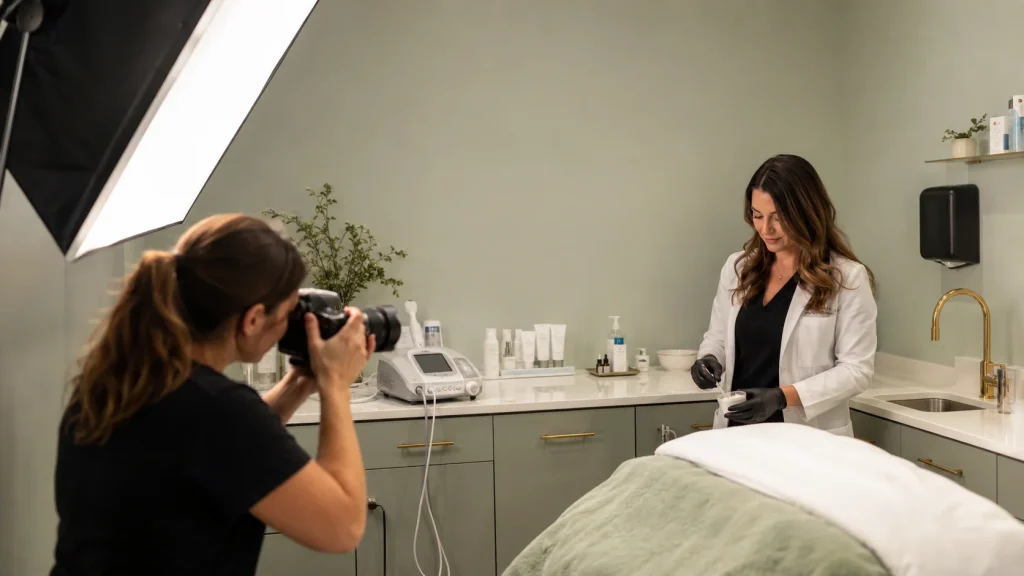
2. Invest in Professional Clinical Photography Stock photos of smiling models in white robes are a trust signal going in the wrong direction. Patients in the aesthetic space have become acutely skilled at identifying stock imagery, and it reduces credibility. Invest in professional photography: real photos of your practice environment, your clinical team, and — where consent permits and regulations allow genuine patient outcomes. In our experience working with aesthetic clinics across multiple markets, switching from stock to authentic photography consistently improves time-on-site and consultation request rates within the first 60 days.
3. Build Every Treatment Page Around Patient Questions Your dermal filler page should not read like a product data sheet. It should answer: What does filler treat? How long does it last? Does it hurt? What does it cost? What should I expect at my first appointment? These are the exact queries patients type into Google and AI search tools like Perplexity and ChatGPT. Answering them on-page drives organic traffic, reduces pre-appointment hesitation, and positions your site as the authoritative resource patients trust not just another provider listing.
4. Place Click-to-Call and Online Booking Above the Fold on Mobile On mobile, your phone number and booking link must be visible without scrolling. A sticky header containing your call button always present as a patient scrolls down any page is the single highest-impact mobile conversion optimization most med spa sites are missing.
5. Create Location-Specific Pages for Every Service Area If your practice serves multiple suburbs or operates across more than one location, create individual pages for each. A page titled “Botox in [Suburb Name]” with locally relevant content and location-specific structured data consistently outranks a generic service page for hyper-local searches where purchase intent is at its highest.
6. Connect and Optimize Your Google Business Profile Your website and GBP must be consistent: identical business name, address, phone number, hours, and service descriptions. GBP optimization is one of the fastest, lowest-cost ways to appear in “near me” searches. Populate your profile with photos, service listings, patient FAQs, and a systematic review acquisition process from day one.
7. Build a Blog and Publish Educational Content Consistently Educational articles targeting patient questions “What is the difference between Botox and anti-wrinkle injections?”, “Is RF microneedling suitable for all skin types?”, “How many sessions of laser hair removal do I need?” build topical authority with Google, drive long-tail organic traffic, and position your practice as the trusted educational resource in your local market. One well-researched, patient-intent-mapped article per month consistently outperforms six thin, AI-spun posts.
Med Spa Website Design Tools and Resources
| Tool | What It Does | Best For |
|---|---|---|
| WordPress + Elementor | Open-source CMS with flexible drag-and-drop builder | Full-control, scalable sites with strong SEO capability |
| Squarespace | Template-based builder with integrated hosting | Quick web presence with minimal technical setup |
| Google Search Console | Monitors search performance, indexing, and Core Web Vitals | Tracking organic traffic and identifying technical issues |
| Google Business Profile | Manages local search listing and patient reviews | Local SEO and “near me” search visibility |
| SEMrush / Ahrefs | Keyword research, competitor analysis, backlink tracking | Building an evidence-based treatment page SEO strategy |
| Hotjar | Heatmapping, session recording, and conversion funnel analysis | Identifying where visitors drop off on key pages |
| RealSelf | Aesthetic-specific review and provider listing platform | Building social proof specifically for cosmetic procedures |
Common Med Spa Website Mistakes To Avoid
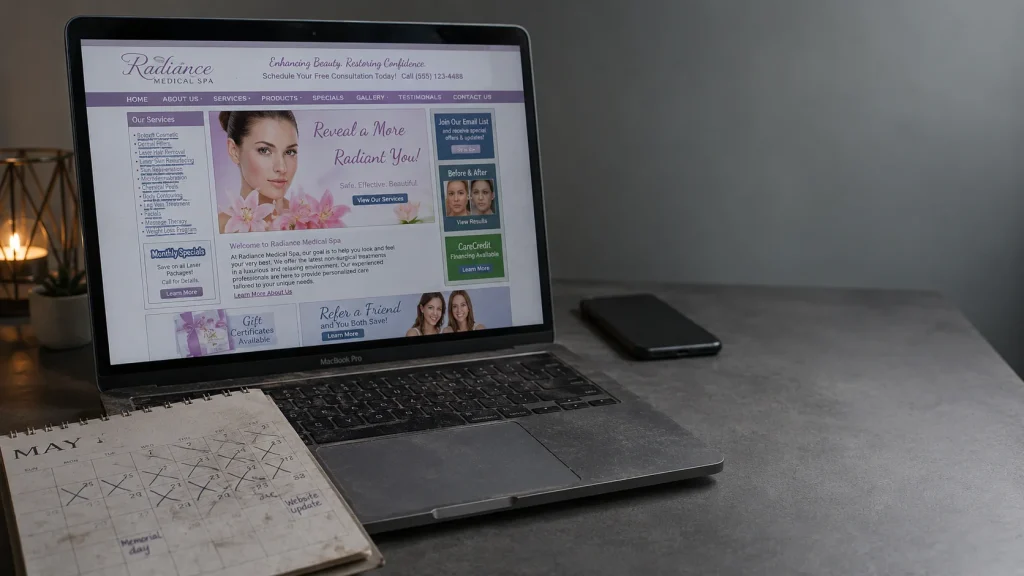
Mistake 1: Treating the Website as a One-Time Project Your website is not a printed brochure. Search algorithms update, patient behavior evolves, and competitors continuously improve their digital presence. A med spa site that is not actively maintained with fresh content, updated treatment pages, and improving page speed will gradually lose ranking positions and organic traffic. Budget for ongoing maintenance from the outset.
Mistake 2: Building and Testing Only on Desktop A site that renders beautifully on a 27-inch monitor may be nearly unusable on a smartphone broken navigation elements, overlapping text, and load speeds that exceed user patience thresholds. Test every page on at least three real mobile devices before launch, and monitor Core Web Vitals monthly through Google Search Console.
Mistake 3: Using Generic Stock Photography Patients considering aesthetic procedures are visually sophisticated. They know the difference between a genuine clinical environment and a stock library photo of a model in scrubs. Commission professional photography for your practice before the site goes live not as an afterthought after launch.
Mistake 4: No Local SEO Infrastructure A med spa website without geo-targeted content, consistent NAP citations across the web, and a connected Google Business Profile is effectively invisible to local searches. Many DIY builds focus entirely on visual design and neglect the technical and content infrastructure that determines whether the site appears in patient searches at all.
Mistake 5: Burying Contact and Referral Information A consistent complaint from referring clinicians including GPs who channel patients to specialist practices is that contact details are difficult to find or are not formatted for easy copy-paste into referral systems. Your clinic phone, fax (if applicable), email, and booking link should be accessible within two clicks from any page. For referral-based practices, a dedicated “For Referring Clinicians” page with all required details in a clean, copyable format is a simple high-return addition.
Mistake 6: Skipping a Compliance Review Healthcare advertising regulations vary significantly by region. In Australia, the Therapeutic Goods Administration (TGA) and AHPRA have strict and actively enforced rules around before-and-after imagery, patient testimonials, and claims made about therapeutic procedures. A non-compliant website is not just a marketing problem it is a regulatory and reputational risk. Have your site reviewed against current local standards before it goes live.
Frequently Asked Questions
What should a med spa website include as a minimum?
At minimum, a functional med spa website needs a homepage, individual pages for each core treatment, an about/team page, a contact and booking page, and full mobile optimization. Beyond these basics, a high-performing site also includes a blog, a patient results gallery (where compliant with local regulations), Google Review integration, and geo-targeted SEO infrastructure across all treatment and location pages.
Why is mobile design so critical for med spa websites in 2026?
The majority of aesthetic treatment searches originate on mobile devices. Google uses mobile-first indexing, meaning it ranks and evaluates your site’s mobile version not the desktop version in search results. A site that performs poorly on mobile will rank lower, load slower, and convert fewer visitors into booked consultations regardless of how good the desktop experience is.
How long does it take to design a modern med spa website?
A professionally built site with proper local SEO infrastructure typically takes 1–2 weeks from initial briefing to launch, depending on the number of treatment pages, photography readiness, and any booking system integrations required. DIY builds typically take longer on average due to the learning curve involved in platform navigation, SEO configuration, and mobile testing.
When should a med spa owner hire a website designer rather than build their own?
Hire a med spa website designer when you are entering a competitive local market, when you want the site to actively generate organic patient leads (not simply provide a web presence), when you have no prior website-building or SEO experience, or when your clinical time is too valuable to spend 40+ hours on a non-clinical skill set. The most common advice from clinicians who have done both: the cost of professional design is recovered quickly; the cost of a poorly optimized first year is not.
Which website platform is best for a med spa?
The right platform depends on your technical comfort level and growth ambitions. WordPress with Elementor offers the most flexibility and SEO control, making it the preferred choice for agencies building patient-generating sites at scale. Squarespace suits a simple web presence with less technical overhead. Custom static HTML sites deliver the fastest load speeds but require ongoing developer maintenance. Wix and similar lightweight builders carry the most limitations from an SEO standpoint and are generally not recommended for practices competing seriously for organic search visibility.
Turn Your Med Spa Website Into a 24/7 Patient Acquisition Engine
Your website is your practice’s highest-leverage marketing asset it should rank locally, build trust, and turn visitors into booked consultations. We design med spa websites built to do exactly that: strong site architecture, local SEO, compliance-reviewed content, all handled for you so you can focus on patients.
No commitment required. Just a clear picture of what your site needs to win in your market.